A case for gender inclusion in African entrepreneurship

Gender inclusion is a critical aspect of entrepreneurship, as it helps ensure that all entrepreneurs have an equal opportunity to succeed, regardless of their gender identity. However, there are several issues that can impact gender inclusion in entrepreneurship: Access to Funding: Women entrepreneurs often face difficulty in accessing capital, which is essential for starting and scaling businesses. This can be due to a lack of access to networks or unconscious bias in the investment community. Stereotypes and Bias: Gender stereotypes can limit the opportunities available to women entrepreneurs, as they may be seen as less capable or less committed to their businesses than their male counterparts. This can also lead to unconscious bias in hiring, investment decisions, and business partnerships. Work-Life Balance: Women entrepreneurs often have to balance their business responsibilities with caregiving and household duties, which can be challenging and impact their ability to grow their businesses. Networking: Networking is a critical aspect of entrepreneurship, but women entrepreneurs may have limited access to networking opportunities due to gender biases and social norms that may exclude them from male-dominated spaces. Role Models and Mentors: Women entrepreneurs may lack access to role models and mentors, which can impact their ability to navigate the challenges of entrepreneurship and develop the skills and networks needed to succeed. Access to Education and Training: Women may have limited access to education and training in entrepreneurship, which can limit their ability to develop the skills and knowledge needed to succeed. Harassment and Discrimination: Women entrepreneurs may face harassment and discrimination, which can impact their mental health, wellbeing, and ability to grow their businesses. Overall, promoting gender inclusion in entrepreneurship requires addressing these issues and creating an environment that is supportive and equitable for all entrepreneurs, regardless of gender identity. This includes providing access to capital, addressing gender biases and stereotypes, promoting work-life balance, fostering networking and mentoring opportunities, providing education and training, and creating a safe and inclusive environment free from harassment and discrimination. As part of its inclusion strategy, AfriLabs, the largest network of innovation enablers in Africa recently launched the RevUp Women Initiative to empower early stage women-led startups in Africa. Find out more about the programme and how it addresses most of the issues outlined above: www.revupwomen.com
AfriLabs with support from Visa Foundation launches the RevUp Women Initiative to empower early stage women-led startups in Africa

AfriLabs, in collaboration with the Visa Foundation launched the RevUp Women Initiative on February 21, 2023, in Lagos, Nigeria. The soft launch event had in attendance a cross-section of high level stakeholders in Africa’s innovation and entrepreneurship ecosystem. The RevUp Women Initiative is aligned with AfriLabs’ inclusion strategy and will offer enterprise development intervention to early-stage women-led African startups and SMEs. The initiative is designed to accelerate women-led businesses into profitable and sustainable ventures that can create jobs on the continent, and the first cohort of beneficiaries will be selected from 5 cities across Nigeria, Kenya, Cameroon, Democratic Republic of Congo and South Africa. The initiative will provide capacity-building training and mentoring to 500 women business owners during the pilot stage. Additionally, 10 women business owners will be selected to receive a $10,000 investment each through the Catalytic Africa matching fund to grow their businesses. Research by the World Bank shows that women make up 58% of Africa’s self-employed population and are more likely to become entrepreneurs than men. Yet, according to data from the AfriLabs – Briter Bridges Innovation Ecosystem Report and AfriLabs Needs Assessment report, women-led businesses in Africa continue to face unique challenges that see them perform poorly compared to men-led enterprises. The challenges range from social issues such as challenging social expectations, building a support network, balancing work and family life, and coping with the fear of failure to business-related issues like limited access to markets, finance, technology and network. The fact remains that women-led enterprises in Africa are not receiving enough support, hence the need for this initiative. Vision Improving Africa’s economy by empowering women-led and women-owned enterprises Project’s activities Leveraging AfriLabs hubs network in 52 African countries to undertake the following: Enterprise development training Mentorship through mentorship networks Peer-to-peer learning workshops Funding through Catalytic Africa Projected impact Sensitise and mobilise stakeholders to create equal growth opportunities for women-led startups and SMEs through RevUp Women Initiative, leading to poverty eradication and inclusive economic growth. Additional funding opportunities for women-led startups and SMEs on the continent A profound increase in investable and scalable women-led startups and SMEs in Africa. More jobs are created by African women-led startups and SMEs. Projected impact numbers by 2026 (after the pilot phase) 50,000 women-led enterprises supported $10 million worth of funding awarded $100 million worth of investment unlocked through investors At least 152,000 jobs will be created in the countries where the initiative is implemented. The initiative will commence its call for applications on February 27, 2023. Interested parties can apply or partner with the initiative through the project’s website – www.revupwomen.com. The initiative is also open to partnerships from stakeholders who share the vision for African women in the business sphere. These include partnerships in the areas of: additional funding through Catalytic Africa; funding additional countries/cities to implement the program, and/or funding the next cohort of the program. There are also opportunities to join the initiative in a non-funding capacity, such as partnering with AfriLabs to provide technical support to the participants (mentoring, coaching, digital tools) and providing visibility for the initiative through communication channels. Media contact: Ajuma Abah (ajuma@afrilabs.com) PR & Communications Manager, AfriLabs
Why We Need To Pay Attention To Supporting Female Entrepreneurs In Africa

In the world of business, women have come to be known as a force to reckon with. Research by the World Bank shows that women make up 58% of Africa’s self-employed population and are more likely to become entrepreneurs than men. Just a few years ago, another research showed that sub-Saharan Africa had the world’s highest rate of women entrepreneurs. Unfortunately, female-led businesses tend to be small and don’t have much room for growth – one of the reasons for this is inadequate training and funding opportunities tailored specifically to meet women’s peculiar needs. Also, most of the available funding seems to go to businesses owned and led by men. Women business owners in Africa continue to face unique challenges, according to data from the AfriLabs – Briter Bridges Innovation Ecosystem Report and AfriLabs Needs Assessment report 2019. The issues range from social issues such as challenging social expectations, building a support network, balancing work and family life, and coping with fear of failure to business-related issues like limited access to markets, finance, technology and networks. Therefore, deploying programmes specifically targeted at women and using delivery methods that are more effective for female entrepreneurs, such as leveraging peer learning and hiring female coaches and mentors, is crucial. The solutions that will bridge this gap need to be enterprise development interventions for businesses owned and led by women. To tackle the challenges, AfriLabs is leveraging its large network of incubators, accelerators and investor networks on the continent to implement the RevUp Women’s Initiative, funded by Visa Foundation. The initiative targets early-stage women-led startups in Africa. The pilot phase of the programme will focus on supporting 500 female led startups across the 5 regions of Africa. This initiative will be officially launched in Lagos, Nigeria on the 21st of February 2023, in the presence of key stakeholders and dignitaries in Africa’s innovation and entrepreneurship community. Stay glued to this space for more information on this noteworthy initiative.
10×1000 Fintech Program

Do you desire growth and expansion for your FINTECH startup this year? Then you should apply for the 10 X 1000 Flex Program! 10 X 1000 Tech for Inclusion is an open and global fintech training platform that enables learners to become drivers of digital economic growth. Its mission is to train 1,000 emerging talents and tech leaders each year for the next ten years. 10×1000 is a philanthropic initiative launched jointly by Alipay and the International Finance Corporation (IFC), a member of the World Bank Group, in 2018. The 2023 10×1000 Flex Program is implemented through AfriLabs. Learn more and apply here: https://bit.ly/10X1000FlexPrograms & apply with case-sensitive code aflt4i
Introducing a Logo for AfriLabs Member Hubs

It is such an honour to belong to this community of innovation enablers and at the Secretariat, we remain committed to offering you as much value as possible. One of such is the unique identifier for members. To make you stand out as a member, AfriLabs is introducing a unique identification, in the form of a “Hub Member” logo attached herewith for your use at any time without prior permission from the Secretariat. As such, the main AfriLabs logo which is different from the hub member logo can only be used for specific scenarios such as: When AfriLabs partners with a hub for an activity. If AfriLabs is not directly involved in a given activity, then the hub member logo is to be used. When a hub member is executing a project funded or powered by an AfriLabs programme. In such scenarios, the following needs to be adhered to: Send an email to Neena Lekwot copying Ajuma Abah and joshua@afrilabs.com requesting permission to use the main AfriLabs logo. Ensure to state the purpose of usage, providing every necessary detail. (You will be notified if the email addresses for this change at any time). If approved by the Management, an approval via email will be sent to you. Please note that the entire process will take approximately 3 weeks. Arabic: https://drive.google.com/file/d/1BqqL0g27jC393mbN4sRpobyUbrGNy9GP/view?usp=share_link English: https://drive.google.com/file/d/1smODQiSkflVeDGFZrSsY_WLYFPkFSG2n/view?usp=share_link French: https://drive.google.com/file/d/1MGzioz0n8EAACx8wmEORopDj4EsqetGh/view?usp=share_link Portuguese: https://drive.google.com/file/d/116eizsuJZMlHROh6phQQY_0W-xRZXcAu/view?usp=share_link Spanish: https://drive.google.com/file/d/1wIhOtXUnRkbkhGwlJ-_5uSnWNc83vVOl/view?usp=share_link
Web 3.0 Africa Information Session
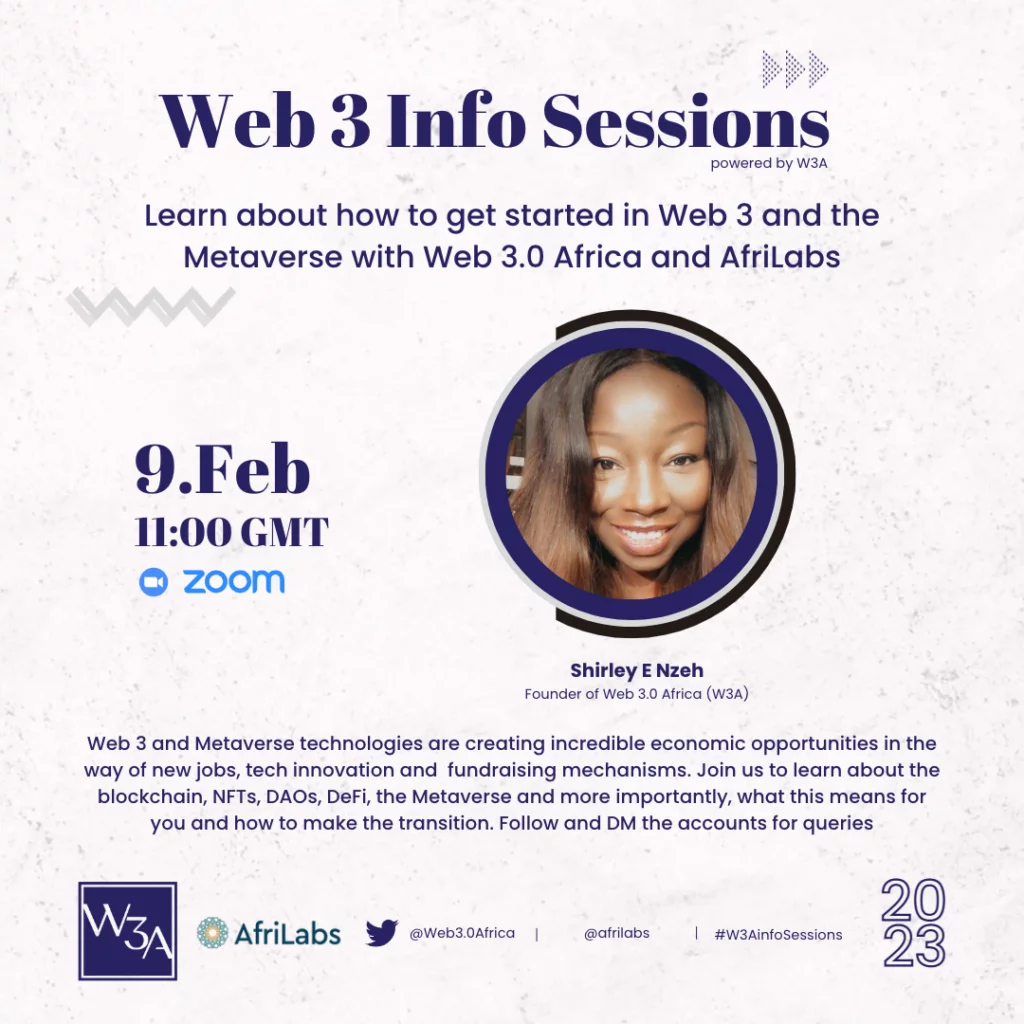
You are invited to a Web 3 information session scheduled to take place on the 9th of February at 11 am GMT via zoom. Web 3.0 is a social enterprise leading the way to the mass adoption of Web 3, XR, and Metaverse technologies in Africa through education. The information session will be centered around Web 3 technology and creating a deeper understanding of the following; The technology, the players, and the opportunities available How to use it to improve financial inclusion and literacy How to create economic opportunity Web 3, components and principles Converting Web 2 skills to Web 3 How to leverage remote work opportunities Using Web 3 to improve your business Using Web 3 to improve your finances and manage inflation Replay the session via https://www.youtube.com/watch?v=MJo4RQWpDvg
Board Election Committee Call for Application
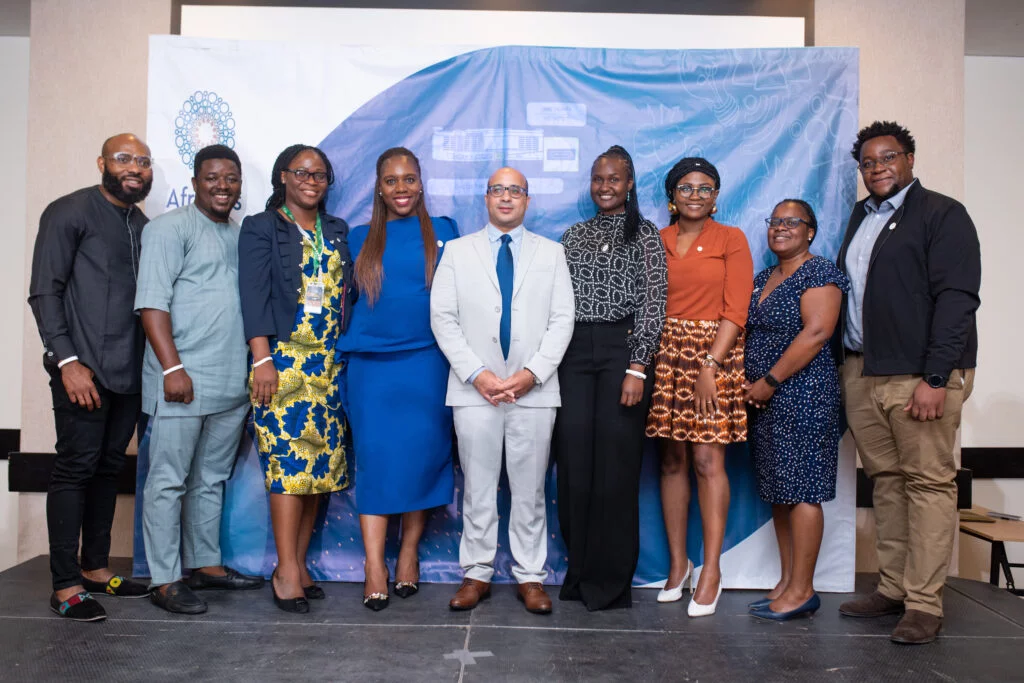
This is an open call for interested women in west and southern Africa to be a part of the electoral committee to enable regional and gender representation as well as provide the necessary experiential support towards ensuring a free and fair election. This year, with the adoption of the new constitution, 8 board positions are up for election which means more demand on the committee to carry out the responsibilities below; Overseeing all tasks carried out throughout the elections period The final approval of election plans and bye-laws laws The review of nominee submissions, and approval/reject the invitations to apply for a board position The review of candidate applications and provide a final verdict for approval/rejection following election guidelines Setting the guidelines for the campaigns of candidates Offering necessary advice and support for a free and fair election Anchoring alongside an existing board member, the election and also declaring the winners based on votes. To be eligible to apply, applicants must; Be an active member of the network for at least 1 year Be a hub Manager or on the Management team of the hub Be willing to dedicate their time and expertise toward the success of the election Not intend to run for any board position for this year (2023) Having electoral experience will be an added advantage. To send in your application please click on the link; Bit.ly/3tt9fuv
AAG2024 Location Bid

We have received your suggestions and paid keen attention to the feedback for hosting the AfriLabs Annual Gathering. To this end, we are happy to announce the opening of the bid for hosting the AfriLabs Annual Gathering 2024. To learn more about hosting the Gathering, Download AAG 2024 Hosting Brochure We look forward to receiving your proposals. For more information or inquiries about the AfriLabs Annual Gathering; please send an email to jen@afrilabs.com and cc: pase@afrilabs.com.
AfriLabs Launches A Novel Digital Engagement Platform for Innovation Enablers in Africa

AfriLabs has launched a digital ecosystem engagement platform – called AfriLabs Connect – to empower the African innovation ecosystem to thrive, accelerate and transform the world. It was unveiled to stakeholders during the recently concluded AfriLabs Annual Gathering 2022. AfriLabs Connect is the digital face of AfriLabs and brings together the largest community of innovation enablers in Africa. Founded to be the solution to the challenges of manually operating the vast AfriLabs network, AfriLabs Connect unites all the stakeholders of the African innovation, technology and entrepreneurship ecosystem digitally to connect, collect, share, collaborate, measure, meet Key Performance Indicators individually and collectively on the web. It provides support and positions the African technology, innovation and entrepreneurship ecosystem as catalyzers for economic growth, development, and transformation while providing easy access to opportunities. It intends to build upon lessons learned by AfriLabs over the years and leverage the unique competitive advantages that each stakeholder group has to offer in order to build a more vibrant pan-African ecosystem. The platform links startups, hubs, investors, academia, development agencies, corporate organisations, governments and the like on a one-stop domain. By presenting a single window of the entire African Innovation Ecosystem, AfriLabs Connect helps to reduce the risk of investment by providing clean data that becomes the foundation to analyse, interpret and plan the next best action, initiative and policy. There are benefits of joining this platform. From improved brand visibility across the ecosystem to unparalleled access to viable opportunities for growth, among others, the platform provides a vast array of advantages to every stakeholder in the ecosystem. In the short time since its launch, hundreds have signed up. Join them by signing up here: www.africonnect.net. About AfriLabs AfriLabs is a network of Africa-based technology and innovation hubs. Founded in 2011 with a mission to support innovation hubs and their communities to raise high-potential entrepreneurs that will stimulate economic growth and social development in Africa, AfriLabs has become the most diverse community of technology hubs, innovators, and entrepreneurs on the continent. AfriLabs has 400 member hubs across more than 250 African cities and the diaspora, with a broader community of over 1,500,000 entrepreneurs, developers, innovators, and startups, making it the largest community of innovation enablers on the continent. Our mandate is to build a community that will empower a thriving innovation economy in Africa. We achieve this through capacity building, financing, networking, policy advocacy, and providing insightful, reliable data. For several years, AfriLabs has served as a convening body bringing together all the critical stakeholders of the African Innovation and technology ecosystem. Our community comprises corporates, government agencies, the academia, donor agencies and investor groups among others.
AfriLabs & Several Partners from Europe & Africa Commence the ONEPlanET Project
AfriLabs & several partners from Europe & Africa have commenced implementation of the Open source Nexus modeling tools for Planning sustainable Energy Transition (ONEPlanET) project across Africa. The project officially commenced on the 1st of November 2022 with the Kick Off Meeting held on 28th of November 2022 online with all project partners and representatives from the European Climate Infrastructure and Environment Executive Agency (CINEA) in attendance. The project aims at empowering African policy makers, research & academia, investors and citizens with the necessary tools and know-how to increase clean energy generation and sustainable use of resources while reducing inequalities and cultural/socio-economic gaps. ONEPlanET will undertake a participatory approach – in three African case studies: Songwe (Malawi/Tanzania), Inkomati-Usuthu area (South Africa) and Niger (Nigeria) river basins – to co-design and test a Toolkit, built upon existing WEF Nexus models and methodologies, that allows to simulate scenarios optimising existing resources with the most appropriate policies considering social, climate, economic and biophysical constraints. In addition, a Knowledge Hub including a set of capacity building materials and knowledge exchange activities will also be developed. ONEPlanET aims at becoming the Toolkit supporting decision-makers in the energy field in their day-to-day work. It will provide open-source tools, models and materials helping them to make informed decisions, considering social, economic and environmental parameters. Through its WEF Nexus models, ONEPlanET aims at becoming the Toolkit supporting African decision-makers in the energy field in their day-to-day work. It will provide open-source tools, models and materials helping them to make informed decisions, considering social, economic and environmental parameters. The project is being coordinated by RINA Consulting, Italy and brings together 11 multidisciplinary partners from 9 different countries in Europe and Africa, with the intention to connect the knowledge, speed up the implementation of the WEF Nexus modeling approach and capitalise the Project’s outputs. These organisations include Europe: RINA Consulting, Italy, Fundación CARTIF, Spain, Universidad de Valladolid, Spain, Three o’clock, France, Stichting IHE Delft Institute for Water Education, Netherlands, Università degli Studi di Genova, Italy, Stiftelsen the Stockholm Environment Institute, Private Sweden. Africa: University of KwaZulu-Natal, South Africa, AfriLabs, Nigeria, Strathmore University, Kenya, Ecowas Centre for Renewable Energy and Energy Efficiency, Public Cape Verde. For this project, AfriLabs will perform the following tasks: Carry out the dissemination and communication activities throughout the duration of the ONEPlanET; Design, launch and manage the ONEPlanET website and communication handles Digital Innovation Portal to provide better infrastructure for the ecosystem; Design communication materials such as graphics, video clips, newsletters and infographics for information dissemination; Create and Engage the stakeholder community throughout the project.