
AfriLabs and ATU Forge Continent‑Wide Pact to Fast‑Track Digital Innovation
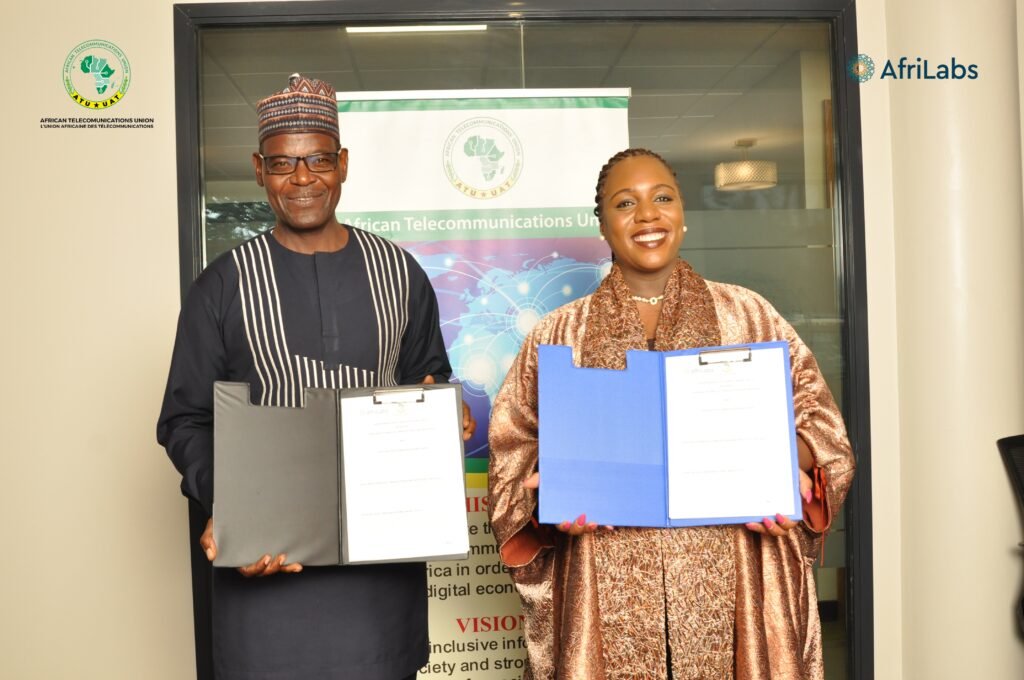
AfriLabs and ATU Forge Continent‑Wide Pact to Fast‑Track Digital Innovation Nairobi, Kenya — 18th July 2025: AfriLabs, the largest pan-African network of innovation hubs, and the African Telecommunications Union (ATU) have signed a landmark Memorandum of Understanding (MoU) to accelerate digital innovation across Africa. This strategic alliance unites ATU’s 52 member states with AfriLabs’ dynamic ecosystem of over 500 innovation hubs across 53 African countries, forging a continent-wide force to drive inclusive technological advancement, empower local solutions, and catalyse transformative economic growth. The MoU in part addresses the widening gap between Africa’s digital potential and current internet access levels. Despite projections that continent’s internet economy could reach $712 billion by 2050, only 38% of Africans were online in 2024, marking the lowest penetration rate among regions covered by the International Telecommunications Union. John Omo, Secretary General of ATU, said: “Our entrepreneurs have the ideas and resilience; however, they continue to face challenges such as fragmented regulations and limited continental visibility. This collaboration with AfriLabs seeks to provide a framework that will enable ATU and AfriLabs to address some of these challenges and innovators to concentrate on addressing practical issues rather than bureaucratic hurdles.” Recognizing the potential growth in mobile internet adoption—forecasted to add nearly a quarter of global new users by 2030 in Sub-Saharan Africa—and anticipating 247 million 5G connections within the same period, ATU and AfriLabs aims to focus their collaboration on nurturing solutions tailored to Africa’s diverse markets so that this surge in connectivity translates into inclusive digital opportunity. Under the partnership, both organizations will jointly promote Africa’s innovation ecosystem. This is expected to take the form of integrating communications across networks of both organisations such as through the annual ATU Africa Innovation Challenge and AfriLabs’ capacity building programmes which provide mentorship, resources and highlights flagship innovations. Anna Ekeledo, Executive Director of AfriLabs, said: “Today’s partnership marks a crucial moment in Africa’s digital journey, by aligning our pan-African network of innovation hubs, innovators and entrepreneurs with the regulatory and institutional influence of ATU, we are laying the groundwork for a future where every entrepreneur, regardless of location, can turn bold ideas into scalable solutions. Together, we will dismantle barriers, cultivate local talent, and build an ecosystem that not only accelerates connectivity but also ensures that the breakthroughs born here are protected, celebrated, and competitive on the global stage.” A significant part of the agreement is the establishment of a joint programme for Intellectual Property (IP) protection and commercialization for African innovators. ATU and AfriLabs will champion policies that strengthen the IP ecosystem and support African startups in protecting their innovations. They will further engage with policymakers, regulators, and other stakeholders to shape a conducive regulatory environment for digital transformation and innovation. The signing of the MoU was completed at ATU’s headquarters in Nairobi. The agreement is part of a broader continental focus aligned with the African Union’s ambitious goal to elevate internet penetration to 80% by 2030 as accounted for in the AU Digital Transformation Strategy for Africa 2020-2030. About the African Telecommunications Union (ATU) An Inter-Governmental Organization (IGO), ATU is the specialised organ of the African Union in the field of Telecommunications/ICTs, and also the International Telecommunications Union’s regional telecommunications organization (RTO) for Africa. The Union represents 52 African countries forming its Member States, and 56 Associate Members comprised of ICT operators in the region. It is an autonomous, membership driven organization whose mission is to promote digital transformation in Africa and ensure the continent is an equal-player in global digital matters. More on the website https://atuuat.africa/ For more information, contact: Alice Koech, Director Cooperation – ATU Email: a.koech@atuuat.africa Phone: +254722510012 About AfriLabs AfriLabs is a leading pan-African network of over 500 innovation and technology hubs across 53 African countries. Established to support the growth of Africa’s innovation and entrepreneurship ecosystem, AfriLabs empowers hubs and their communities by providing capacity-building programs, strategic partnerships, funding opportunities, and advocacy for enabling policy environments. By fostering collaboration among key stakeholders, governments, the private sector, academia, and development partners, AfriLabs is catalyzing sustainable solutions driven by African talent, technology, and innovation. Through its work, AfriLabs plays a pivotal role in accelerating digital transformation, job creation, and inclusive economic growth across the continent. Learn more: www.afrilabs.com. For more information, contact: E: pr@afrilabs.com & comms@afrilabs.com
Breaking Down Barriers for Entrepreneurs in Africa: AfriLabs at the 4th AU MSME Forum 2025
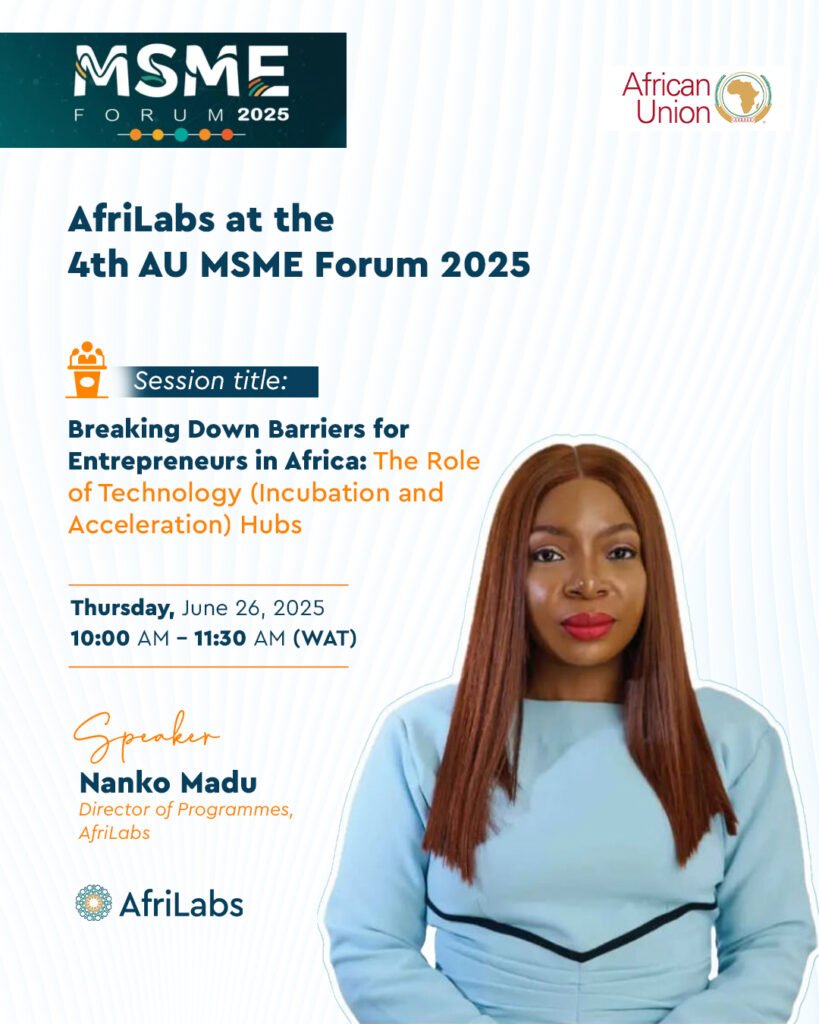
Breaking Down Barriers for Entrepreneurs in Africa: AfriLabs at the 4th AU MSME Forum 2025 The African innovation ecosystem will take center stage at the 4th Annual African Union Micro, Small, and Medium-Sized Enterprises (MSME) Forum, under the theme “Building Resilient MSMEs through Digital Innovation, Market Access & Affordable Financing for Africa.” The event, hosted by the African Union Commission (AUC) in collaboration with the Government of Nigeria, will bring together over 300 stakeholders to shape inclusive pathways for entrepreneurship across the continent. Among the high-impact sessions during this week-long forum, AfriLabs is set to participate in a critical conversation on “Breaking Down Barriers for Entrepreneurs in Africa: The Role of Technology (Incubation and Acceleration) Hubs.” The session is scheduled for Thursday, June 26th, from 10:00 AM to 11:30 AM, WAT. Representing AfriLabs will be Nanko Madu, Director of Programmes, who brings a wealth of experience on how innovation hubs are supporting Africa’s emerging and growing entrepreneurial talent. The session will convene leading accelerators, incubators, and innovation enablers to unpack the vital role that tech hubs play in nurturing early-stage startups, especially in environments marked by limited funding, fragmented infrastructure, and constrained market access. The conversation aims to spotlight how hubs are anchoring Africa’s digital transformation by: Providing startups with access to training, mentorship, and funding opportunities Driving inclusive digital adoption among MSMEs Bridging local entrepreneurs with continental and global markets. Helping startups navigate regulatory hurdles and compliance challenges Promoting inclusive innovation by targeting women- and youth-led businesses. AfriLabs, with its network of over 500 hubs in 53 African countries, plays a critical role in enabling this transformation. Through its programs and advocacy, AfriLabs fosters an environment where African startups can scale and thrive. Set against the broader backdrop of the African Union’s strategy to empower SMEs, this session complements the forum’s focus on digital tools, intra-African trade, and structural financing. Delegates will engage with actionable strategies to: Mobilize public-private partnerships to fund entrepreneurial infrastructure Align hub efforts with the African Continental Free Trade Area (AfCFTA) to promote intra-African commerce Embed environmental, social, and governance (ESG) principles in entrepreneurial development Encourage joint policy-making efforts between governments and ecosystem enablers Highlight replicable success stories and data-backed outcomes of incubation and acceleration programs. As African economies look to MSMEs as the backbone of job creation and innovation, the forum’s agenda aligns closely with AfriLabs’ mission: to support the development of a knowledge-driven, innovation-led economy across the continent. AfriLabs invites ecosystem actors, investors, policymakers, and partners to join this vital session and explore how collaborative models can dismantle persistent barriers for African entrepreneurs. Event Details Date: Thursday, June 26, 2025 Time: 10:00 AM – 11:30 AM (WAT) Venue: Abuja Continental Hotel, Abuja, Nigeria Speaker: Nanko Madu, Director of Programmes, AfriLabs To learn more about our participation, please contact Shaka Mutuku at shaka@afrilabs.com
AfriLabs Secures $150,000 Unrestricted Donation from Airbnb Community Fund

AfriLabs Secures $150,000 Unrestricted Donation from Airbnb Community Fund AfriLabs, the largest pan-African network of innovation and technology hubs, is pleased to announce its approval for a generous donation of $150,000 from the Airbnb Community Fund. The Airbnb Community Fund is dedicated to supporting organizations that are making a tangible difference in key areas. These areas include environmental sustainability, economic empowerment, mental health, and the prevention of abuse and exploitation, all of which create meaningful impacts in local communities. By extending this donation to AfriLabs, Airbnb reinforces its belief in the transformative potential of innovation hubs to drive social and economic development on the continent. This unrestricted donation provides AfriLabs with the flexibility to channel funds where they are most needed, ensuring the organization’s continued ability to adapt to emerging challenges, foster collaboration, and scale its initiatives to support over 500 innovation hubs and thousands of entrepreneurs across 53 African countries. Anna Ekeledo, the Executive Director of AfriLabs, highlighted the importance of the partnership: “This generous donation from the Airbnb Community Fund is a testament to the power of collaboration and shared vision. With this funding, we can deepen our efforts to support innovation hubs that nurture entrepreneurs, accelerate solutions to pressing challenges, and drive sustainable impact across communities. Together, we are shaping an inclusive and innovative future for Africa.” AfriLabs’ partnership with Airbnb’s Community Fund underscores their shared commitment to being transformative forces for impactful change. Together, they serve as platforms for cultivating innovative solutions that address both local and global challenges. About AfriLabs: AfriLabs is a Pan-African network of over 500 innovation hubs across 53 African countries designed to drive sustainable economic growth across the continent through investment, innovation, technology, and entrepreneurship. About The Airbnb Community Fund: Created in 2020, the Airbnb Community Fund is a commitment to serve our stakeholders and give back in the places our Hosts call home. The Community Fund will distribute $100 million USD by the end of 2030 to strengthen communities around the world. We work closely with stakeholders, including Airbnb Hosts, to identify causes that are important to them and support organizations making a difference in those areas. These include issues like environmental sustainability, economic empowerment, mental health, and ending abuse and exploitation. For media inquiries, please contact pr@afrilabs.com & comms@afrilabs.com.
CALL FOR APPLICATIONS: JOIN THE TIMBUKTOO MINETECH ACCELERATOR PROGRAMME
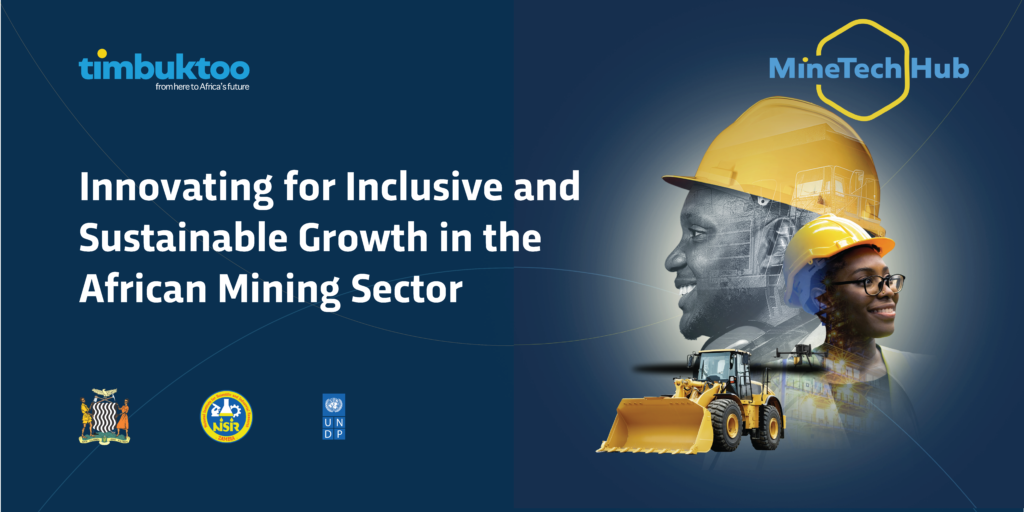
CALL FOR APPLICATIONS: JOIN THE TIMBUKTOO MINETECH ACCELERATOR PROGRAMME 9th JANUARY 2025, ZAMBIA — The United Nations Development Programme (UNDP), in partnership with the timbuktoo Africa Innovation Foundation, and National Institute for Scientific and Industrial Research (NISIR) are excited to announce the timbuktoo MineTech Accelerator Programme, a transformative initiative of the timbuktoo MineTech Hub designed to drive innovation in mining technology, empower start-ups, and scale transformative technologies in the African mining sector. The timbuktoo MineTech Hub is a first of its kind on the African Continent with a focus on reimagining the mining industry through the empowerment of youth-led startups. The Accelerator Programme provides access to networks, high tech products, and financial resources. Through the Accelerator Programme, the timbuktoo initiative aims to foster sustainability and operational efficiency, unlocking new opportunities for socio-economic development across the continent. Key Funding and Call for Applications The timbuktoo MineTech Accelerator Programme aims to identify and support innovative mining-tech start-ups from across Africa, focusing on tech-enabled solutions that revolutionise the mining industry. The selected start-ups will receive access to mentorship, funding, and link to global networks, enabling them to scale and implement cutting-edge solutions that address critical challenges in the sector. For the second phase of the programme, the selected start-ups will each receive $25,000 in equity-free funding, enabling them to refine their solutions and scale their businesses. Applications for this opportunity open from January 9, 2025, and close on February 13, 2025. Startups across Africa are encouraged to apply and contribute to transforming the mining and technology landscape. “The timbuktoo MineTech Accelerator Programme reflects our dedication to addressing critical challenges in Africa’s mining sector while empowering local talent,” said James Wakiaga, Resident Representative of UNDP Zambia. “This initiative not only fosters innovation but also provides vital financial and mentorship support for start-ups that will shape the future of sustainable mining.” The Chief Executive Officer of NISIR, Dr. Henry Kambafwile, further emphasised the transformative potential of the MineTech Accelerator programme, noting “This programme is more than just an opportunity for start-ups—it’s a catalyst for reshaping Africa’s mining sector with technology and innovation at its core. By empowering Africa’s brightest minds, we are positioning the continent as a leader in sustainable and ethical mining practices.” Programme Objectives The MineTech Accelerator Programme seeks to achieve the following key objectives: Promote Innovation: Develop cutting-edge technologies that enhance mining operations. Support and Scale Startups: Accelerate the growth and investment readiness of emerging ventures in mining technology. Enhance Capacity: Equip entrepreneurs with essential skills through targeted workshops and mentorship. Foster Collaboration: Build partnerships among industry leaders, investors, regulators, and academia. Drive Economic Growth: Contribute to regional socio-economic development through technology-driven advancements. Programme Scope and Activities The initiative unfolds in several strategic phases to provide comprehensive support for start-ups: Recruitment and Bootcamp: Start-ups from across Africa will be selected via outreach, partnerships, and community engagement. The 4-week bootcamp broken down as 2-weeks in person and 2-weeks virtual will include: • Problem definition exercises • Prototype development and personas • Business modelling and market validation • Pitch development workshops Start-ups will refine problem statements, map target markets, and align their solutions with industry needs. Acceleration Phase: After the bootcamp, the selected start-ups will advance to a tailored acceleration phase, with the opportunity to be awarded $25,000 in equity-free funding. Participants will gain access to mentorship, market opportunities, product refinement, and strategic guidance. Timbuktoo MineTech Hub: The Hub hosted at NISIR will facilitate collaboration with regulators, mining corporations, and innovation hubs across Africa. Outreach activities will engage a wide range of stakeholders through webinars, social media campaigns, and curated events. Post-Grant Support: The programme will offer post-grant support to ensure start-ups have the resources and guidance they need to continue growing, scale their solutions, and drive impact. Eligibility and Focus Areas Start-ups applying to the programme must meet the following criteria: Founders must be nationals of an African Union member state and be domiciled in Africa. Start-ups must address mining industry challenges using technology-based solutions. The programme strongly encourages applications from women, persons with disabilities, and marginalised groups. Focus areas for the MineTech Accelerator include: Waste management and efficient mineral recovery. Data visualization and interpretation. Drone applications and surveying. Sustainability-focused mining innovations. Join the Movement Start-ups in the mining and technology sectors are encouraged to seize this opportunity to redefine the African mining ecosystem. With substantial funding and support available, the programme promises to nurture transformative innovations and drive sustainable economic growth. For more information about the timbuktoo MineTech Hub and to submit an application, click this link. For more information and media interviews, contact: Salome Nakazwe, Head of Solutions Mapping for the UNDP Accelerator Labs, salome.nakazwe@undp.org Dr Kutemba Kapanji, Head of Materials, Engineering and Technical Services, Kaunakakai@gmail.com/ kkakoma@nisir.org.zm Mercy Khozi, Communications Analyst, UNDP Zambia, mercy.khozi@undp.org, +260211386200 Oluwagbemisola Fagbemi, Communications and Liaison Officer, UNDP Africa, oluwagbemisola.fagbemi@undp.org ABOUT TIMBUKTOO MINETECH HUB The MineTech Hub is a first-of-its-kind Pan-African innovation and acceleration Hub dedicated to transforming the mining sector through tech-enabled innovation and sustainability. Located at the National Institute for Scientific and Industrial Research (NISIR), in Lusaka, Zambia, and launched as part of the United Nations Development Programme’s (UNDP) timbuktoo initiative, the MineTech Hub empowers startups, entrepreneurs, and researchers to pioneer solutions that enhance operational efficiency, safety, and environmental responsibility in the mining industry. By fostering innovation, catalysing investment, and addressing critical challenges in mining, the Hub aims to position Africa as a leader in tech-enabled, sustainable mining spark Africa’s startup revolution. For more information, visit: https://www.undp.org/zambia/timbuktoo-minetech-hub ABOUT TIMBUKTOO The timbuktoo initiative targets to mobilise and invest USD 1 billion over 10 years to support 10,000 startups, scale 1000 startups, to impact 100 million livelihoods, and create USD 10 billion value on the African continent. The moonshot targets innovation on a pan-African scale through strategically selected “Hubs” which will be sector-specific and engage with startups from across the continent. The thematic Hubs (Accra – AgriTech; Kigali –
The Second Cohort of the African Union Digital and Innovation Fellowship Programme Announced at AfriLabs Annual Gathering 2024
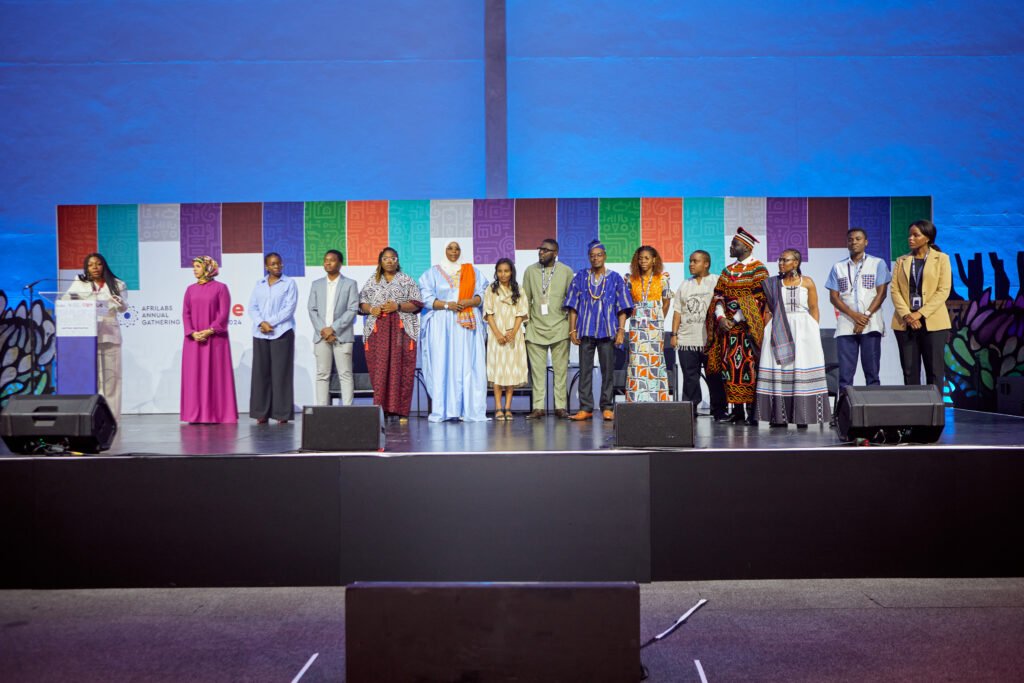
The Second Cohort of the African Union Digital and Innovation Fellowship Programme Announced at AfriLabs Annual Gathering 2024 Cape Town, South Africa – At this year’s AfriLabs Annual Gathering, held from November 6-8 at the Cape Town International Convention Centre (CTICC 2), the African Union (AU) proudly announced the second cohort of the AU Digital and Innovation Fellowship Programme. This year’s Annual Gathering was a success, uniting a diverse network of innovators, thought leaders, policymakers, and entrepreneurs from across the African continent to advance the conversation on technology-driven growth. The AU Digital and Innovation Fellowship Programme is a transformative 12-month initiative designed to position Africa’s top tech innovators as “resident fellows” within AU headquarters. These fellows play a pivotal role in analysing AU unit systems, identifying challenges in data management, and co-creating innovative solutions tailored to enhance efficiency. By fostering capacity-building among AU staff, the fellowship not only drives immediate improvements but also ensures the sustainability of these innovations well beyond the fellowship term. Launched in March 2024, the second edition of the fellowship programme attracted an impressive 3,000 applications from young African innovators. After a rigorous selection process, 19 exceptional fellows were chosen and deployed to 13 AU host units, where they will work on strengthening data processes, improving digital systems, and gaining valuable skills in leadership, entrepreneurship, and professional development. The fellows are: Felix Fomengia Atabonglefac (Cameroon) – Fellow at the Office of the Director General (ODG). Nkosingiphile Ntshangase (South Africa) – Digital and Innovation Tech Fellow at the Information Society Department (ISD). Ceasar Waweru Kabue (Kenya) – Fellow at the Office of the Director General (ODG). Ornella Ahouandogbo – Digital and Innovation Tech Fellow at the African Continental Free Trade Area (AfCFTA). Kofi Mensah Abaya (Ghana) – Fellow at the Africa CDC. Apiwe Hotele (South Africa) – Fellow at the AUDA-NEPAD Coordination Unit. David Tufe Nzadon (Nigeria) – Fellow at the MIS Division. Rabia Moussa (Niger Republic) – Fellow at the Sustainable Environment & Blue Economy (SEBE) team. Stephen Amoakoh Donkor (Ghana) – Fellow at the Information and Communication Directorate. Frida Ndi (Cameroon) – Fellow at the Women, Gender and Youth Directorate (WGYD). Thamsanqa Kunta-Kinte Ngcobo (South Africa) – Fellow at the African Union – InterAfrican Bureau for Animal Resources (AU-IBAR). Hagernesh Tadesse (Ethiopia) – Fellow at the Information and Communication Directorate (ICD). Waiswa Ronald Mironda (Uganda) – Fellow at the Office of the AU Youth Envoy (OYE). Melkam Mekonnen (Ethiopia) – Software Developer fellow at the Africa CDC. Mekitmfon Herbert AwakEssien (Nigeria) – Fellow at the Economic Development, Tourism, Trade, Industry, Mining (ETTIM) unit. Thokozile Manaka (Lesotho) – Data Scientist and fellow at the Africa CDC. Goodnews Sunday Sandy (Nigeria) – Fellow at the Information Society Department (ISD). Dereje Mulat Ferede (Ethiopia) – Fellow at the AU Innovation Lab. Christabel Onwuka (Nigeria) – Fellow at the Africa Centres for Disease Control and Prevention (Africa CDC). Nanko Madu, Director of Programmes at AfriLabs, expressed optimism for the program’s impact: “This fellowship program exemplifies the power of innovation to drive sustainable change. By placing top innovators within the African Union, we’re bridging the gap between talent and opportunity, laying the foundation for future leaders who will champion digital transformation across the continent.” The fellows shared their aspirations and excitement as they embark on this journey. Thokozile Manaka, a fellow deployed to the Africa CDC, said: “I anticipate that this fellowship will be a pivotal opportunity to collaborate with experts and develop innovative digital health solutions that not only enhance healthcare delivery but also inform evidence-based policies. By leveraging data and technology, I aim to contribute to a sustainable framework that addresses Africa’s unique health challenges and drives systemic improvements across the continent.” Mekitmfon Herbert AwakEssien, a fellow to the Economic Development, Tourism, Trade, Industry, Mining (ETTIM) unit, emphasised: “As I embark on this fellowship, I see it as a crucible for transformative change. I’m eager to learn from Africa’s brightest minds, contribute my expertise in digital development, network with visionaries across the continent, and ultimately take actions that will catalyse Africa’s digital revolution and transformation. This is my chance to turn ideas into action, and action into impact.” Another inspiring voice, Kofi Mensah Abaya, a fellow at the Africa CDC, added: “As a fellow with the Africa CDC, I am determined to collaborate on initiatives that enhance public health infrastructure and promote sustainable health outcomes across the continent. In alignment with Agenda 2063, which envisions ‘an integrated, prosperous, and peaceful Africa,’ I am of the view that digital health innovations can play a pivotal role in achieving these goals.” The African Union Digital and Innovation Fellowship Program continues to embody the vision of Agenda 2063 by developing a network of skilled innovators who contribute directly to the growth and integration of digital solutions across the AU’s core operations. AfriLabs remains committed to supporting initiatives that foster collaboration and advance Africa’s innovation landscape. About AfriLabs- AfriLabs is a Pan-African network of over 500 innovation hubs across 53 African countries designed to drive sustainable economic growth across the continent through investment, innovation, technology, and entrepreneurship. About African Union The African Union (AU) is a continental body consisting of 55 member states representing the continent of Africa. Its vision is to achieve an integrated, prosperous, and peaceful Africa, driven by its own citizens and representing a dynamic force in the global arena. For more information about the African Union Digital and Innovation Fellowship Onboarding Event contact aufellowship@afrilabs.com, Lisa@afrilabs.com, and cc Chibudu@afrilabs.com. For general information about the AU Digital and Innovation Fellowship Programme, please visit www.auinnovationfellowship.com. For media inquiries, please contact pr@afrilabs.com & comms@afrilabs.com
AfriLabs Annual Gathering 2024: Spotlight on Seven Dynamic Tracks Shaping Africa’s Innovation Landscape
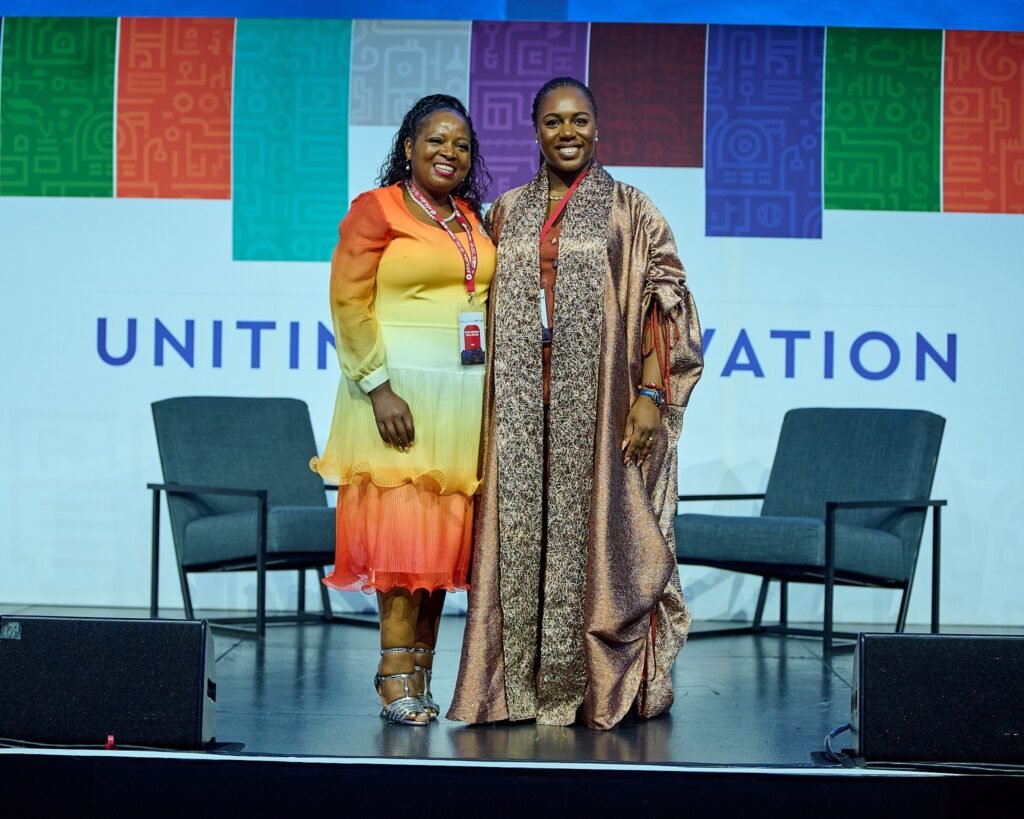
AfriLabs Annual Gathering 2024: Spotlight on Seven Dynamic Tracks Shaping Africa’s Innovation Landscape Cape Town, South Africa – The AfriLabs Annual Gathering 2024, held from November 6-8 at the Cape Town International Convention Centre 2 (CTICC 2), was a resounding success, bringing together a diverse network of innovators, thought leaders, policymakers, and entrepreneurs from across Africa. This year’s event marks the 9th iteration of the AfriLabs Annual Gathering with the theme “Uniting Innovation,” placing a strong emphasis on seven thematic tracks: Green and Blue Economy Track, Gender and Inclusion Track, Investor/Investment Track, Hub Solutions Track, Policy, Data, and AI Track, Creative Digital Economy Track and Makerspaces. Each track represents a cornerstone of Africa’s rapidly evolving innovation landscape and serves as a vibrant platform for dialogue, exchange, and strategic planning aimed at shaping a sustainable and inclusive future for Africa. In collaboration with RLabs, a leader in South Africa’s innovation ecosystem, AfriLabs spotlighted Cape Town’s vibrant entrepreneurial landscape. The city’s breathtaking scenery and rich cultural heritage created a unique setting for a Gathering that left a lasting impact on Africa’s innovation landscape. AfriLabs’ Executive Director, Anna Ekeledo, expressed the unifying ethos of the event during her opening remarks, saying, “AfriLabs proudly stands as a Pan-African community. Though we are a tapestry of rich diversity, we are united by a shared purpose: to build a lasting legacy that will shape generations to come.” Deputy Minister Raesetja Jane Sithole of South Africa’s Ministry of Small Business Development delivered an inspiring keynote address, emphasising the country’s commitment to fostering accessible opportunities. “The future of South Africa’s growth lies in empowering diverse entrepreneurs. By reducing red tape and supporting informal and micro-enterprises, we’re ensuring that opportunities are accessible to all, especially youth, women, and people with disabilities,” she stated, reflecting the event’s dedication to inclusive, sustainable growth across Africa. The Creative Digital Economy Track, provided an immersive exploration into Africa’s creative sector, discussing the fusion of technology and creativity that powers Africa’s burgeoning digital arts, gaming, and content sectors. Topics ranged from “Diaspora to Homeland: Building a Connected Future” to “Independent Filmmaking in the Digital Era” and “Gaming for Impact.” The track gathered esteemed voices like Mathew Mensah, Ambassador for Ghana Tourism and Co-founder of Act Africa, and Henry A Stokes, Senior VP of The African Channel among many others. Speakers dove into themes of African storytelling, the opportunities for Africa’s creative industries on the global stage, and the potential of digital platforms to drive the sector’s growth. The track underscored the potential of Africa’s creative economy to bridge cultural, technological, and economic divides, all while empowering the continent’s youth and creatives. Addressing the essential role of Policy, Data, and AI in Africa’s development, this track convened policymakers, tech leaders, and AI specialists to discuss ethical AI, cultural alignment in AI design, and policy frameworks that empower data-driven innovations. From “AI in Africa: Accelerating Africa’s AI Footprint” to “Digital Public Infrastructure: The Role of Policy and AI in Sectoral Transformation,” the discussions examined how a responsible AI and data strategy could support sustainable growth and innovation. Notable speakers included Dr. Rachel Sibande from the Bill & Melinda Gates Foundation, Mario Romao, Intel’s Director of AI Policy, and representatives from both the AU and the South African government, who explored the policy requirements for Africa’s AI future. The Hub Solutions Track centred on the foundational role of innovation hubs in Africa’s entrepreneurial landscape. This track presented strategies for hubs to “scale up”, sessions included a “Design Thinking Masterclass” and panel discussions on “Hub Evolution” and “Strategic Partnerships.” Experts like Alfredo Cuanda, Founder & Business Designer at Ideario and Tomi Davies, Chief Investment Officer at TVC Labs, shared insights on strategies for specialisation and global collaboration and creating hubs with a “10x” impact, positioning hubs as central to nurturing localised innovation and facilitating access to resources, training, and mentorship. Rebecca Enonchong, CEO of AppsTech, shared sentiments on empowering young startups which resonated deeply here, as she emphasised, “Our mission is to be a steady hand for entrepreneurs, guiding them from ideation to growth. By investing in them, we’re investing in the future of Africa—one startup, one idea at a time.” The Investment Track united investors and startups to discuss Africa’s investment ecosystem and the pathways to attract both local and global capital. Thought leaders such as Tomiwa Aladekomo, CEO of Big Cabal Media, Julia Price, Co-Founder/Director at Linea Capital and Spiwe Sibanda, Development Bank of Southern Africa’s Credit Risk Executive, delved into topics on “The state of Investment by Tech Cabal insights” and “Navigating Investment Risks and Returns” and “The Future of Investment: Insights into the current landscape and future trends in African & Global Investments.” The discussions emphasised the critical need to develop new financing frameworks, partnerships, and de-risking mechanisms that empower African entrepreneurs and accelerate growth across underserved communities. In the Gender and Inclusion Track, leaders and advocates gathered to highlight the impact of gender equity and inclusivity in the tech ecosystem. Through panel discussions like “Tech-Enabled Financial Inclusion” and “Inclusive Digital Ecosystems: Women and Disability Participation,” speakers explored how Africa’s tech landscape could benefit from a broader representation of voices, talents, and perspectives. Noteworthy contributors included Hema Vallabh, Founding Partner at Five35 Ventures, and Baratang Miya, Founder of Girlhype Women Who Code. This track advocated for equal opportunities and supportive environments for women and underrepresented groups, emphasising the critical importance of inclusivity in fostering resilience and diversity in Africa’s innovation ecosystem. The Green and Blue Economy Track delved into Africa’s sustainability challenges and the potential of green technologies to foster resilient ecosystems. Topics such as “Harnessing Technology for Resilient Agricultural Eco Parks” and “Collaborative Policies for Environmental Resilience” were discussed by speakers including Buffy Okeke-Ojiudu, CEO of Zebra Group, Tigele Nlebesi, Ventures Associate at ALX Ventures and Uche Ekeledo, CEO at Fosu. The track offered a vision for a sustainable Africa through enhanced environmental governance, leveraging both natural resources and advanced technologies for growth in agriculture, water resources, and sustainable trade.
AfriLabs Announces Global Powerhouses as Partners for the 2024 Annual Gathering: Driving Innovation and Collaboration Across Africa
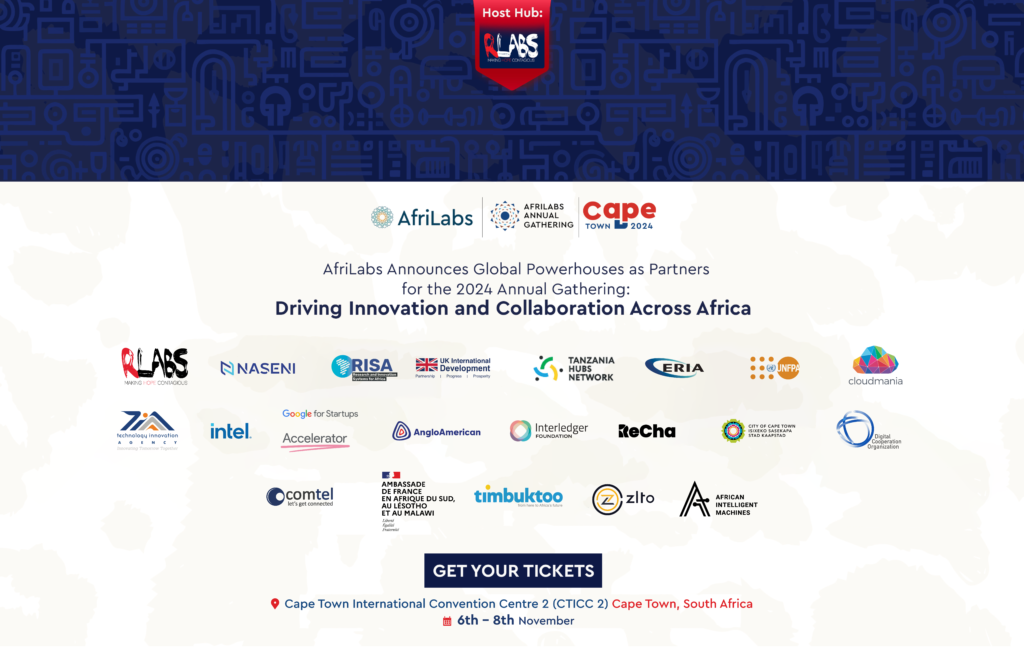
AfriLabs Announces Global Powerhouses as Partners for the 2024 Annual Gathering: Driving Innovation and Collaboration Across Africa AfriLabs is pleased to announce the partners for the 2024 AfriLabs Annual Gathering, to be held from November 6th to 8th in Cape Town, South Africa at Cape Town International Convention Centre 2 (CTICC 2). This year’s theme, “Uniting Innovation”, emphasizes the importance of collaboration to drive economic growth and social development through Africa’s innovation ecosystem. The event will feature seven key tracks, each focusing on pivotal sectors that are essential for Africa’s future: Makerspaces Green and Blue Economy Gender and Inclusion Investment Hub Solutions Policy, Data, and AI Creative Digital Economy These tracks will highlight opportunities and challenges in sectors vital to Africa’s future, showcasing how innovation can foster sustainable growth. AfriLabs is proud to collaborate with prominent global organizations, including: RLabs: Our esteemed Host Hub for this year’s AfriLabs Annual Gathering is not just a partner but a cornerstone of the event. With a remarkable history of fostering entrepreneurial spirit and technological advancement, RLabs brings a wealth of experience and expertise to the gathering. NASENI (Nigeria): The National Agency for Science and Engineering Infrastructure will showcase its efforts in driving innovation and industrialization across Nigeria. Research & Innovation Systems for Africa Fund (RISA): RISA’s efforts to strengthen the research landscape across Africa complement AfriLabs’ ongoing work to provide insightful, reliable data to innovators and entrepreneurs on the continent. Economic Research Institute for ASEAN and East Asia (ERIA): ERIA brings global expertise in economic integration, digital inclusion, and SME promotion, enhancing collaboration between East Asia and Africa. Cloudmania: Cloudmania, Liquid C2’s award-winning distribution business unit, specializes in delivering cloud and cyber security solutions with operations across the Middle East and Africa. Through its strategic partnership with Microsoft, Cloudmania equips numerous partners with cloud and cyber security services and solutions, including Microsoft 365 and Azure, all within a fully supported ecosystem. Tanzania Hub Network: Dedicated to building a vibrant, interconnected innovation ecosystem in Tanzania, this partner’s work, supported by UNDP’s FUNGUO Innovation Programme, in empowering hubs for socio-economic development resonates with AfriLabs’ pan-African mission. Technology Innovation Agency (TIA): TIA Plays an essential role in bridging the gap between research and commercialization. Their participation in this year’s event underscores the importance of ensuring that Africa’s innovative ideas translate into impactful, market-ready solutions. Digital Cooperation Organization (DCO): DCO is another prominent partner contributing to the development of Africa’s digital economy policies and fostering global strategic partnerships Intel: As a long-time partner, Intel will be hosting a roundtable on AI policy, providing a platform for African and global thought leaders to explore the future of AI in a rapidly evolving digital landscape. UNFPA: UNFPA, also a long-standing partner, will lead a panel discussion and workshop on leveraging innovation to enhance sexual and reproductive health programming for African youth. Additionally, UNFPA will host an exhibition booth to showcase SRHR Innovation solutions, offering valuable insights into advancements in sexual and reproductive health across the continent. Google: As a key partner at the AfriLabs Annual Gathering 2024, Google will be participating in activities aligned with its accelerator program, aiming to foster growth in the African startup ecosystem by equipping founders with essential resources and expertise for success both locally and globally. Additional partners include Interledger Foundation, Anglo American, ReCha, Comtel, South African Future Trust Foundation, African Intelligent Machines (AIM), ZIto, the French Embassy and the City of Cape Town (CoCT). These partners will contribute to advancing cross-border collaboration, innovation, digital inclusion and local empowerment while supporting a shared commitment to Africa’s innovation-driven future. “The support of our partners is not only a testament to the global relevance of Africa’s innovation ecosystem but also to the importance of collaborative efforts in driving sustainable development across the continent.” – Anna Ekeledo, Executive Director of AfriLabs “We are excited to partner with AfriLabs, a leading player on the African continent. We look forward to scaling up our activities in digital inclusion and green innovations to connect ecosystem builders, innovators, and start-ups across Asia and Africa.” – Dr. Giulia Ajmone Marsan, Head of Startups and Inclusion, ERIA Digital Innovation and Sustainable Economy Center With an impressive lineup of partners, the AfriLabs Annual Gathering 2024 promises to be a revolutionary event, uniting visionaries and innovators committed to shaping Africa’s future. Register today at AfriLabs Annual Gathering and secure your tickets here. About AfriLabs AfriLabs is the largest network of technology and innovation hubs across Africa, driving the growth of Africa’s innovation ecosystem. With a mission to support the development of the African technology and innovation ecosystem, AfriLabs connects hubs and other stakeholders to facilitate collaboration, resource sharing, and knowledge transfer. Follow AfriLabs on social media at @afrilabs and visit our website, www.afrilabsgathering.com and www.afrilabs.com for updates on the event, tracks, and registration. For media inquiries, please contact pr@afrilabs.com& comms@afrilabs.com
Uniting Innovation: The Future of Africa’s Tech Landscape
Uniting Innovation: The Future of Africa’s Tech Landscape As Africa’s tech ecosystem continues to evolve, the need for unity and collaboration has never been more pressing. The AfriLabs Annual Gathering 2024, which will take place from November 5th to 8th, 2024, under the theme “Uniting Innovation,” promises to bring together innovators, policymakers, and industry experts to shape the future of Africa’s tech landscape. According to a joint report by Google and the International Finance Corporation titled “e-Conomy Africa 2020”, the internet economy in Africa is projected to reach $180 billion by 2025, accounting for 5.2% of the continent’s GDP. This growth is driven by increased internet access, urbanization trends, and a vibrant startup ecosystem (IFC). At this year’s AfriLabs Annual Gathering (AAG), AI emerges as a pivotal theme. AI has the potential to dramatically enhance these projections. McKinsey & Company estimates that AI could boost Africa’s GDP by up to $1.2 trillion by 2030. Already, AI applications in healthcare, finance, and other sectors are demonstrating significant impacts, from improving diagnostic accuracy to enhancing financial inclusion. Discussions at AAG 2024 will focus on strategies to harness AI’s transformative power, aiming to accelerate economic growth and foster sustainable development across the continent (McKinsey & Company). Another critical track is sustainability, a theme that resonates deeply in Africa, where the impact of climate change is already being felt. Innovators and policymakers will come together to discuss how technology can be used to drive sustainable development and build resilient economies. For instance, renewable energy sources like solar and wind power have the potential to reduce carbon emissions by up to 70% in Africa, according to the United Nations. The future of work is another area of focus, as Africa grapples with the challenges of unemployment and skills development. The conversation at AfriLabs will center around how innovation and technology can create new opportunities for employment and entrepreneurship. The African Development Bank estimates that digital technology could create up to 230 million jobs in Africa by 2030, with a significant portion of the workforce engaged in the gig economy (Global Institute). Healthtech, fintech, and edtech are also on the agenda, as Africa’s innovators showcase solutions that are revolutionizing healthcare, finance, and education. For example, mobile health (mHealth) solutions have improved healthcare outcomes in Africa, with a study by the World Health Organization showing that mHealth interventions have increased vaccination rates by up to 20% in some countries. Beyond technology, the AfriLabs Annual Gathering emphasizes unity and collaboration. It seeks to unite diverse perspectives to drive innovation and sustainable development in Africa’s evolving tech ecosystem. Join us at the AfriLabs Annual Gathering 2024 and be part of the conversation that will shape the future of Africa’s tech landscape.
The Imperative of AI Infrastructure Investment for Africa’s Digital Future
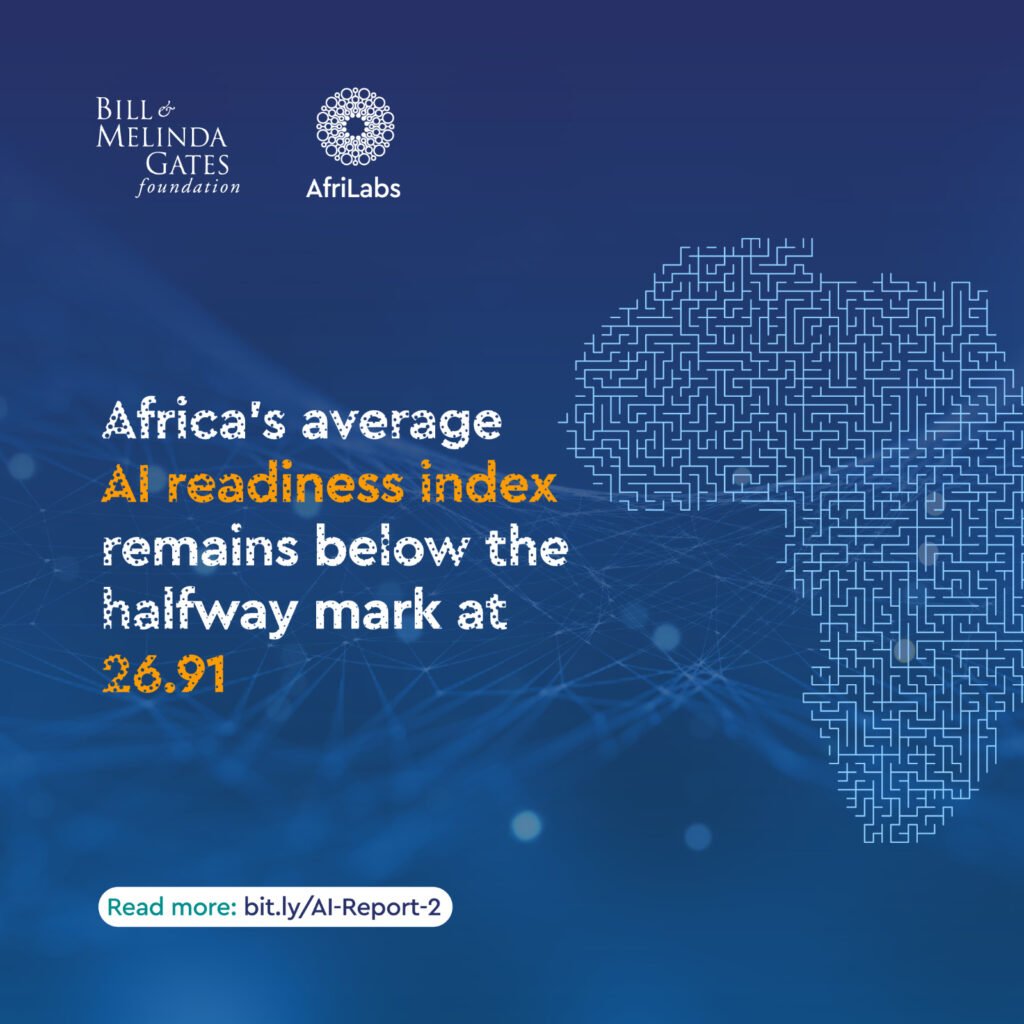
The Imperative of AI Infrastructure Investment for Africa’s Digital Future As we approach a new era powered by artificial intelligence (AI), the need for strong internet infrastructure in Africa has never been more important. The AI Startups Mapping in Africa report by AfriLabs, funded by the Gates Foundation provides a sobering but positive assessment of the continent’s AI readiness, with an average index of 26.91. This figure, which is far below the halfway point, emphasizes the vital need for further efforts and expenditures to boost AI activity across the continent. Bridging the AI Readiness Gap Despite Egypt, Kenya, South Africa, and Tunisia leading with index values above 40, none have achieved 50. This suggests that even the most advanced African countries are still in the early phases of AI development. Without substantial improvements in digital infrastructure, Africa risks falling further behind in the global AI race. The surge in AI applications necessitates an increase in high-performance computing (HPC) capabilities, such as GPUs and TPUs. These components are essential for developing and deploying complex AI models that rely on massive datasets and intricate computations. Over the past decade, global investments in digital infrastructure have soared, driven by factors like smartphone penetration and the rise of cloud computing. However, Africa must ramp up these investments to meet the evolving demands of AI. The Role of Digital Infrastructure Effective AI infrastructure is multifaceted, encompassing hardware and software elements that provide a broad range of capabilities. From data storage and cloud computing to robust communication networks and secure power connections, each component is crucial for unlocking AI’s full potential. For Africa, building this infrastructure is not just about technology; it’s about creating a foundation for innovation and socioeconomic development. Several initiatives are already underway, African countries are adopting digital strategies aimed at fostering an environment conducive to digitalization. Tech giants such as Amazon, Google, and Microsoft are investing in African data centers, rapidly expanding the continent’s hosting capacity. For instance, the establishment of the Tanzania National Internet Data Center (NIDC) exemplifies how government and private sector collaboration can enhance AI capabilities. By providing scalable storage and AI services, the NIDC is helping Tanzanian entities to leverage AI without the need to develop services from scratch. Specialization in AI Subfields African AI startups are showing remarkable focus in various AI subfields, which is crucial for addressing the continent’s unique challenges. The report highlights that 30% of AI startups in Africa specialize in Machine Learning, followed by Deep Learning (17%), Natural Language Processing (15%), Computer Vision (12%), Generative AI (10%), Reinforcement Learning (9%), and Robotics (7%). This specialization is pivotal for driving innovation in sectors like healthcare, finance, and agriculture, where AI can significantly improve outcomes. However, the growth in AI subfields also brings to light the urgent need for better infrastructure. As AI algorithms become more complex, the demand for computational power increases. Without the necessary digital backbone, these startups may struggle to scale their solutions and achieve their full potential. The Path Forward Africa’s digital infrastructure development requires a concerted effort to enhance digital infrastructure. This means investing in state-of-the-art data centers, expanding cloud computing capabilities, and ensuring reliable and fast communication networks. For instance, Tanzania’s licensing of public data centers from the private sector reflects a positive trend, but it must be scaled up to meet the high computing demands brought by AI. Governments across Africa must prioritize creating a safe and secure foundation for AI development. This involves not only building the physical infrastructure but also implementing policies that promote innovation, protect data privacy, and ensure cybersecurity. By doing so, Africa can create an ecosystem where AI can thrive, driving socioeconomic development and positioning the continent as a significant player in the global AI landscape. The future of AI in Africa holds immense promise, but realizing this potential hinges on the continent’s ability to build and sustain robust digital infrastructure. The AI Startups Mapping in Africa report serves as a clarion call for action. By addressing the current gaps and investing strategically in AI infrastructure, Africa can unlock unparalleled opportunities for innovation and development, ensuring that it does not just participate in the AI revolution but leads it. In the words of many experts, the time to act is now. The benefits of AI are too significant to be overlooked, and the costs of inaction are too high. Africa’s digital future depends on the steps we take today to build a foundation that can support the technologies of tomorrow. 📖 Read more in our report: bit.ly/AI-Report-2
African Union Digital and Innovation Fellowship: What We Have Learnt So Far
by Taiye Salami, Project Officer, and Stephanie Titcombe, Project Associate at AfriLabs In the third quarter of 2021, the German Federal Ministry for Economic Cooperation and Development (BMZ)’s vision to support the mandate of The African Union (AU) via its commission (the African Union Commission), through the GIZ DataCipation project, materialized into what is now the AU Digital and Innovation Fellowship Program. The aim of the program is to identify and deploy highly competent technology innovators from the African continent to units and organs within the African Union headquarters as resident fellows. The mandate of the fellows is to understand the system within their assigned units, identify data and process management challenges and lead the development and the deployment of sustainable and innovative technology solutions. AfriLabs as the implementing partner designed and managed the project’s implementation which includes but is not limited to the identification and deployment of the fellows to their respective units in Addis Ababa, Banjul, and Accra in Ethiopia, The Gambia and Ghana respectively. After a few months of doing this, we have a couple of insights to report on our experience so far. Here are some of the important lessons we have learnt so far: Get stakeholder buy-in fast The level of success the program has recorded so far can be traced to the support the fellows have received from the African Union Commission and GIZ DataCipation Teams to ensure that they hit the ground running immediately after resumption. The experience has confirmed what we already factored into our design; that the buy-in of all relevant stakeholders from top-to-bottom is critical to the performance and the success of the fellows in an institution like the African Union Commission. The abundance of talents on the continent One of the key objectives of this program is to source for and identify the best talents that the continent has to offer. It took us several months to do that but based on the profile and quality of applications received, we can state for a fact that there is an abundance of young talents in Africa. Be iterative but ensure to accommodate for existing systems and processes We discovered very quickly that we had to find a balance between what we are used to (which is to understand the challenges, context and the affected, co-design a solution with all relevant stakeholders, then commence implementation and monitor from start to finish) and what it takes to effectively function and deliver at the African Union Commission. There are reasons why the existing systems and processes are in place and to better innovate in such an environment, a thorough understanding of the status quo especially during implementation is required. This lesson prompted the training and encouragement of the fellows to not just be agile but to also respect and leverage existing systems and processes. Leverage an inclusive approach Africa is a continent of diverse countries, cultures and languages but we have one common interest; the growth, development, independence, and sustainability of the continent. To ensure the inclusion of eligible young data and technology enthusiasts across Africa, we designed and implemented a non–barrier application and review process that factored in gender, geographical location, and language were critical parts of the review and selection process. The review and selection process also leveraged three of the most widespread African Union languages: Arabic, English and French, which resulted in over 700 applications from across the continent, and a merit-based selection process in assessing the applicants. This approach ensured that none of the applicants from across the region suffered discrimination based on gender, religion, or political affiliations. The entire process produced an equal spread of male and female fellows for the program. We expect to learn more in the coming weeks on how to plan and execute an impactful pan-African programme, so stay with us as we keep you updated on the activities of the pilot edition of the fellowship.