
Bridging the Gap: AfriLabs at the DCO General Assembly on Africa’s AI and Digital Future
Across Africa and the Arab world, national AI strategies are being written, ministerial portfolios are being restructured, and digital cooperation frameworks are being signed. Inside the continent’s universities, the picture is more complicated. The question is no longer whether AI matters for the continent’s economic future. It is whether the institutions responsible for producing that future’s workforce are equipped to keep pace.
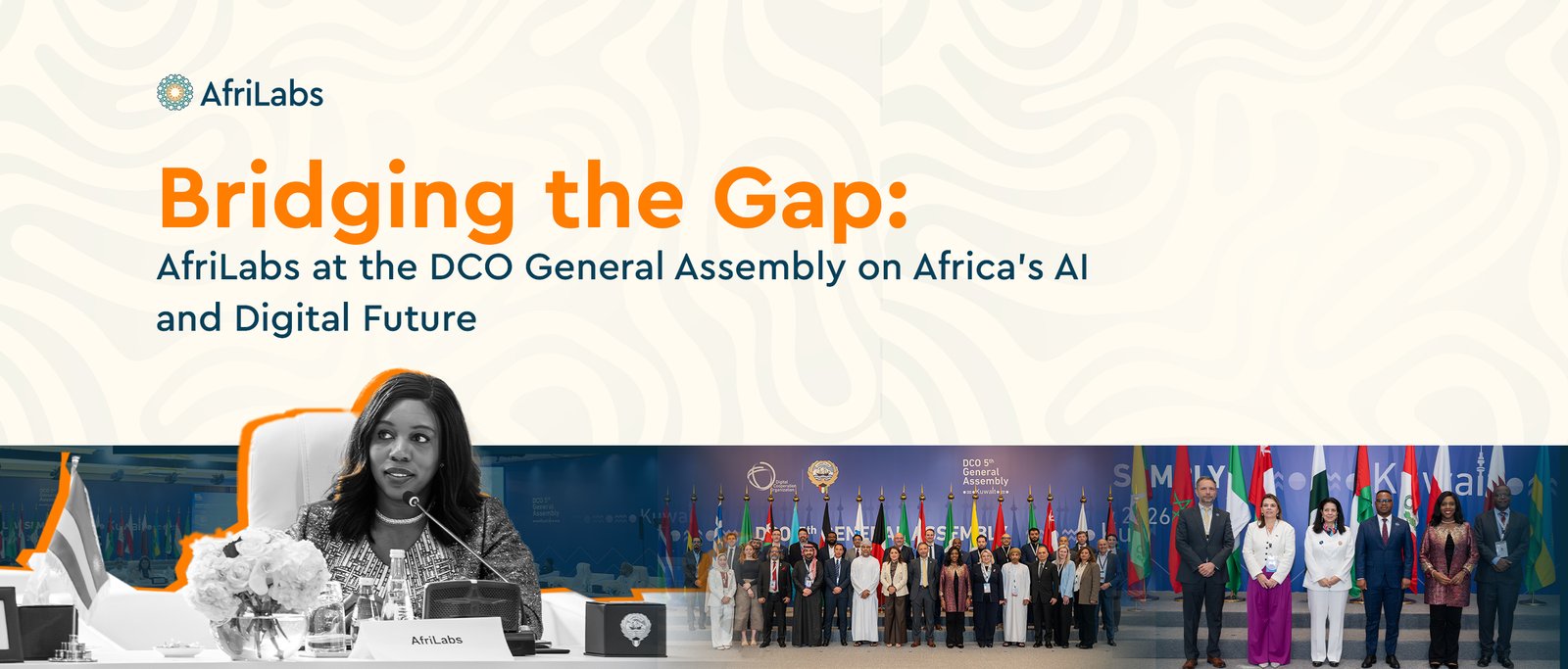
At the 5th DCO General Assembly in Kuwait, AfriLabs joined a high-level side-event co-hosted with the Kingdom of Morocco on “Strengthening African-Arab Partnerships for Artificial Intelligence and Data-Driven Development.” Our Executive Director, Anna Ekeledo, participated alongside H.E. Dr. Amal El Fallah Seghrouchni, Morocco’s Minister of Digital Transition and Administrative Reform, and H.E. Yves N. Iradukunda, Rwanda’s Minister of State for ICT and Innovation, in a session moderated by Ms. Emma Morley, UNDP Resident Representative in Kuwait. The discussion was focused on a unified digital transformation agenda across both regions.
AfriLabs came to that table with something specific: evidence.
What the Data Actually Shows
In November 2025, AfriLabs, WISE (Qatar Foundation), Mohammed VI Polytechnic University (UM6P), and The Education Collaborative at Ashesi University published “Harnessing AI for Higher Education in Africa,” a study drawing on responses from 3,875 stakeholders across 47 African HEIs and 199 edtech companies. It is one of the most comprehensive examinations of AI adoption in African higher education produced to date.
The findings reveal a sector caught between recognition and readiness. Most institutions understand the direction of travel. Few have built the internal conditions to move confidently in that direction.
62% of all AI usage across surveyed institutions occurs within AI-enabled Learning Management Systems. Adoption beyond that is scattered. Six in ten institutions have no AI policy. The same proportion operate without ethical guidelines for responsible AI use. Respondents widely described their institutions as being at an early or developing stage of AI integration, even where individual staff reported intermediate competency levels.
The gap is not in awareness. It is in institutional architecture.
This matters because the absence of governance frameworks does not simply slow adoption. It creates the conditions under which adoption, when it does happen, is fragmented, inconsistent, and difficult to build on.
A Market That Has Not Caught Up
The edtech investment landscape reflects the same structural imbalance. Of 414 active post-secondary edtech startups operating in Africa, only 45 specifically target HEIs. Fewer than 2% are building AI-powered solutions for the tertiary level. 64% of edtech activity remains concentrated at K–12.
This is a rational market response to a set of structural disincentives. HEIs involve complex procurement processes, longer sales cycles, limited dedicated budgets in public institutions, and significant content adaptation requirements. Startups building for universities carry more risk for slower returns. Meanwhile, over 83% of AI startup funding in early 2025 flowed to just four countries: Kenya, Nigeria, South Africa, and Egypt, concentrating capital in ecosystems that are already better resourced and leaving HEI-focused innovation largely unfunded across the rest of the continent.
41% of edtech startups in our study cited funding and revenue generation as their primary obstacle. Without capital structures designed for the complexity of higher education markets, AI solutions for African universities will continue to be built by too few players, at too small a scale, to drive systemic change.
Infrastructure Is the Starting Point, Not the Backdrop
None of the above can be addressed without confronting the infrastructure reality directly. Africa holds less than 1% of global data centre capacity despite representing 18% of the world’s population, and the continent needs an estimated 700 new data centres to meet medium-term connectivity and storage requirements. No African country has yet reached 20% AI adoption, a figure shaped by five compounding deficits: electricity, data infrastructure, internet access, skills, and language.
For African HEIs, these deficits are not abstract. They determine whether a faculty member can reliably use an AI tool in a classroom, whether an institution can afford to run cloud-based administrative systems, and whether students in under-resourced regions have any meaningful access to the tools their urban counterparts are beginning to use.
Our study found that lack of affordable internet access and adequate hardware consistently ranked among the top barriers to AI adoption in universities. AI policy frameworks and faculty training programs are necessary investments. But they operate on top of a connectivity and compute layer that, in much of the continent, is not yet stable enough to carry them.
What Implementation Actually Looks Like
Our research does not only identify gaps. It documents what structured, intentional implementation looks like when conditions align.
The case study we conducted with UM6P in Morocco, currently ranked first in Morocco and North Africa and fourth across the continent in the 2026 Times Higher Education rankings, offers the clearest available model for African HEI-led AI integration. UM6P approached AI not as a set of tools to adopt, but as a design challenge. Its Digital Ecosystem Office coordinates all AI and digital initiatives campus-wide, ensuring that technology adoption is grounded in pedagogy rather than novelty.
The outcomes are measurable. Course development timelines fell from 8–12 weeks to 2–3. Instructional video production costs dropped by up to 70%. In 2025, UM6P became the first African HEI to deploy ChatGPT Edu institution-wide, giving more than 2,000 students and faculty access within a policy-controlled environment and generating institutional learnings now shared beyond Morocco.
UM6P is a well-resourced institution, and our report acknowledges that directly. But its approach is transferable: identify a specific problem, ground the solution in pedagogy, design for scale from the start, and build human capacity alongside every tool deployed. These are principles, not budgets.
The UM6P model demonstrates that the constraints facing African HEIs are real but not deterministic.
Policy Is Moving. Implementation Needs to Follow.
Rwanda’s 2023 National AI Policy and Kenya’s National Artificial Intelligence Strategy 2025–2030 both place higher education institutions at the center of national AI implementation, calling for expanded curricula, postgraduate training, and structured research-industry partnerships. These frameworks signal a shift from aspiration to architecture at the national level.
The DCO General Assembly in Kuwait reflected the same shift regionally. Ministerial discussions have moved decisively from exploring digital opportunity to building the sovereign capability required to act on it. The African-Arab partnership being shaped through platforms like the DCO is not ceremonial. For Morocco, Rwanda, and the growing number of member states with formal AI strategies, these partnerships represent a mechanism for shared infrastructure, knowledge transfer, and coordinated investment.
AfriLabs operates at the junction between that policy momentum and the institutional realities our research documents. Representing a network of over 500 innovation hubs across the continent, our role is to ensure that the frameworks being designed at the ministerial level are informed by what is actually happening inside Africa’s universities, startups, and research institutions.
The Work Ahead
The 5th DCO General Assembly was one data point in a longer trajectory. The research AfriLabs brought to Kuwait will continue to inform our advocacy, our programming, and our partnerships. As we look ahead to GITEX Africa 2026, alongside UM6P, WISE, and The Education Collaborative, the agenda is clear: move the conversation from what African HEIs should do about AI, toward the specific governance, infrastructure, and investment conditions that will allow them to do it.
Africa’s higher education institutions are not peripheral to the continent’s AI future. They are where that future’s workforce is being prepared. The decisions made now, about policy, capital, and infrastructure, will determine whether that preparation is adequate to the moment.
The evidence exists to make those decisions well. The question is whether the right people are using it.
Read the full report: https://bit.ly/WISE-REPORT-2025